

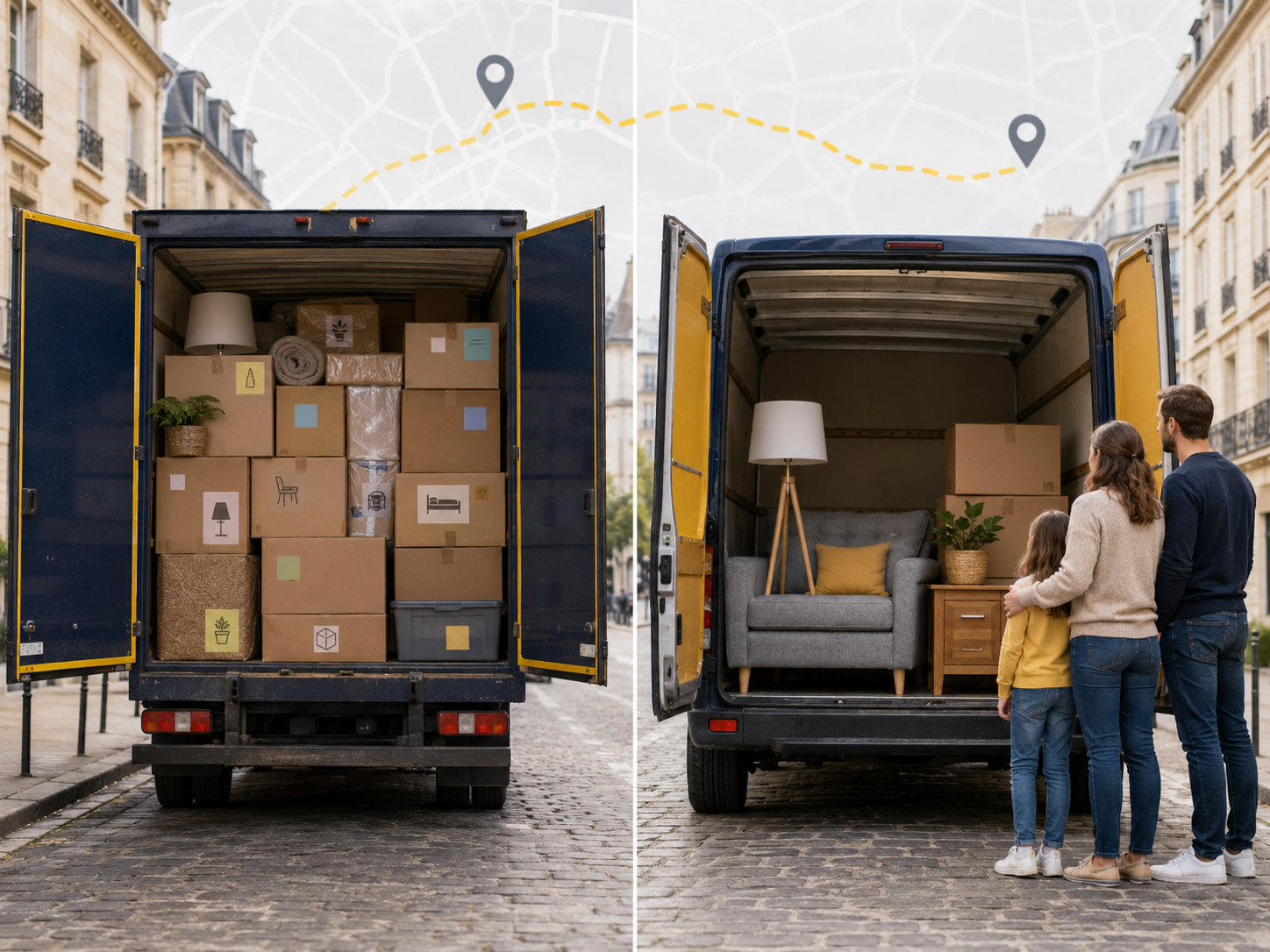
When you get quotes for a European move, you’ll be offered two main ways of doing it. The words sound technical. The idea is simple.
Here’s the difference, and how to pick.
Part-load: sharing the space
Your belongings travel alongside other people’s, in a van heading the same way. You pay for the space you use, not the whole vehicle.
What’s good about it: it’s the cheaper option, often by a lot. It’s ideal when you’re not moving a whole house — a flat’s worth, a few rooms, or the essentials while you find your feet.
The trade-off: you fit around a schedule rather than setting it. The van leaves when the route works, and there may be a few drop-offs along the way. Delivery is a window rather than a precise hour.
Best for: smaller loads, flexible dates, and anyone keeping costs down.
Dedicated van: the whole vehicle, just yours
One van, your belongings only, driving from your door to your new one.
What’s good about it: speed and control. It leaves when you need it to and goes straight there. Nothing is handled more than it has to be, which matters if you’re moving anything fragile or valuable.
The trade-off: you’re paying for the whole van, so it costs more.
Best for: whole-house moves, tight dates, valuable or delicate items, and anyone who wants it done in one clean run.
A simple way to decide
Ask yourself three questions:
How much are you moving? Under a van’s worth → part-load is usually the sensible choice. A full house → a dedicated van is often better value anyway.
How fixed are your dates? Flexible → part-load. Must arrive by a specific day → dedicated.
What’s in the load? Everyday furniture and boxes → part-load is fine. Antiques, art, instruments, or anything irreplaceable → dedicated, every time.
What actually drives the price
Whichever you choose, the cost comes down to the same handful of things:
- Volume — how much space your belongings take up
- Distance — Calais is not Lisbon
- Access — narrow streets, no parking, or a fourth-floor flat with no lift all add time
- Extras — packing, dismantling, storage at either end
A good quote is based on a proper survey of what you’re actually moving, not a guess over the phone. If a price seems oddly low, check what’s included — especially packing, customs handling and delivery to the room rather than the kerb.
A middle option worth asking about
If your dates are flexible but your load is large, ask about a dedicated van with a shared return leg. You get the whole van going out, and the mover fills it on the way back. It sometimes lands neatly between the two on price. Not every company offers it, but it’s worth a question.
FAQ
Is a part-load cheaper than a dedicated van? Usually yes, often significantly. You only pay for the space you use rather than the whole vehicle, but you fit around the route’s schedule.
How long does a European move take? A dedicated van is generally quicker as it drives direct. A part-load takes longer because of route planning and other drop-offs. Your mover should give you a realistic window for your destination.
Which is better for fragile items? A dedicated van. Your belongings are loaded once and unloaded once, with no transfers along the way.