

Some moves are hard because there’s a lot to move. Others are hard because of the last thirty feet.
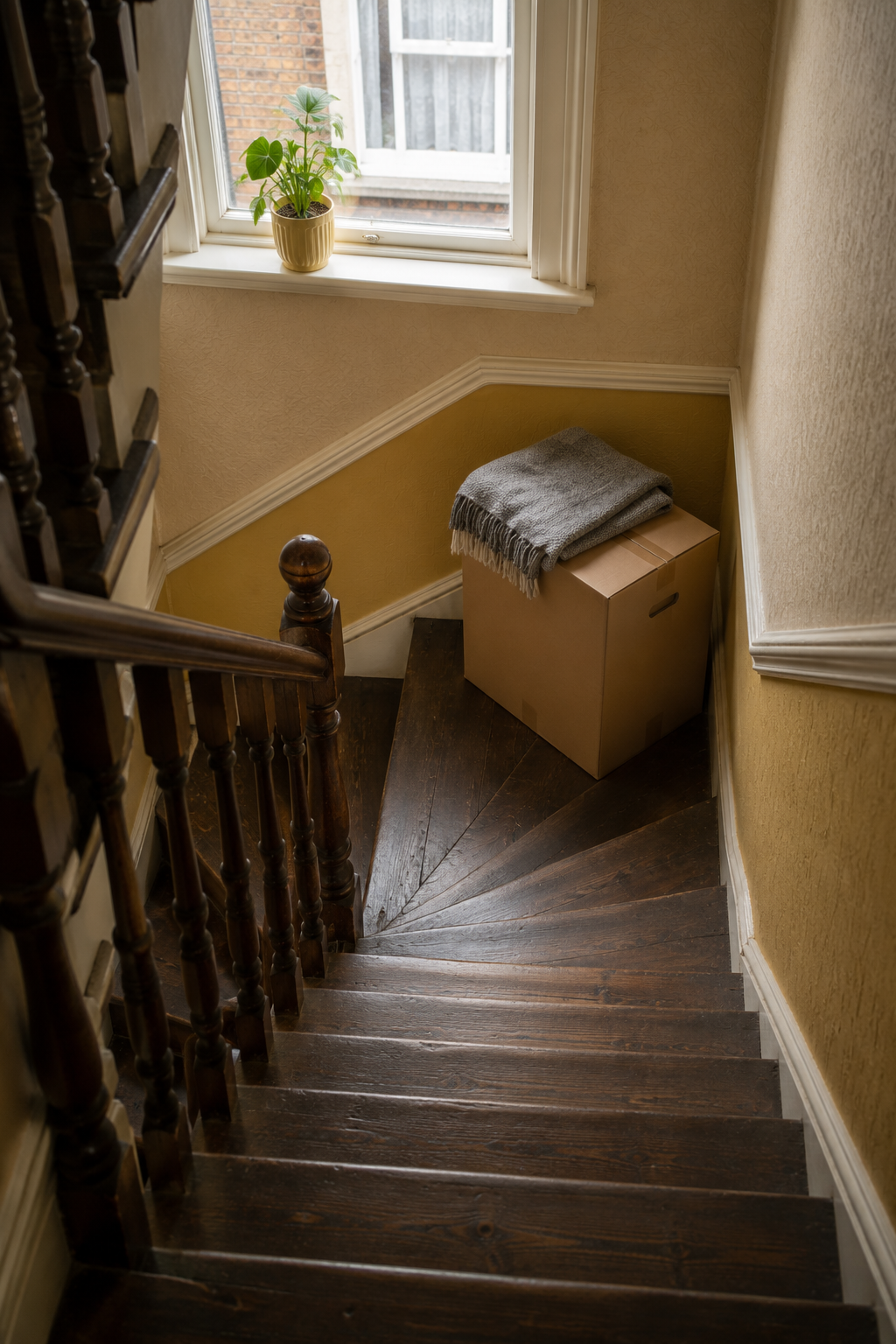
A third-floor flat with no lift. A terraced street where the nearest parking space is round the corner. A narrow Victorian staircase with a turn halfway up that no sofa has ever willingly gone round.
Access is the thing that quietly decides how long a move takes — and it’s the thing people most often forget to mention when booking. Here’s how to plan for it.
Why access matters more than distance
A move across the city with easy parking at both ends can be quicker than a move two streets away where everything’s carried a hundred metres and up three flights.
That’s not a pricing trick. Carrying a wardrobe up four flights genuinely takes several times as long as wheeling it off a tail lift into a hallway.
Which is why the single most useful thing you can do is tell your mover about the access before they quote, not on the day.
Stairs
If there’s no lift, a few things help a lot:
- Clear the stairwell completely before anything starts — no bikes, no bins, no boxes on landings
- Prop the doors open, including the communal one
- Measure the turns, especially where a staircase doubles back. That’s where big items get stuck
- Dismantle what you can. A bed frame in pieces goes anywhere; a bed frame assembled goes almost nowhere
- Empty the drawers. A loaded chest of drawers on a staircase is both dangerous and unnecessary
Lifts (when there is one)
A lift helps enormously, but only if you can use it.
Check whether your building lets you book the lift for a move — many do, and it stops you waiting behind neighbours all morning. Some buildings require padding or protective covers inside the lift, and some restrict moving hours entirely.
Measure the lift too. A lift that takes people comfortably may not take a sofa at all.
Parking — the big one
This is where most moving-day problems actually start.
Check the restrictions outside both properties. Permit zones, single yellows, loading bays with time limits, and residents’ bays are all common in Coventry’s older streets.
Ask the council about a suspension or dispensation if you’ll be blocking a bay or need a longer stop. It takes a few working days to arrange, so this is a fortnight-out job, not a Friday-afternoon one.
Tell your neighbours. Genuinely effective. A polite note a few days early asking if they can leave a space clear works far more often than people expect.
Have a backup. Know where the nearest legal spot is if the ideal space is taken.
Narrow streets and tight lanes
Some streets simply can’t take a large van. Low bridges, width restrictions, sharp turns, or a lane too narrow to pass parked cars.
If your street is like this, say so when booking — a smaller van doing two trips is usually far better than a big van that can’t get near the door.
Things worth checking in advance
- The width of the front door and any internal doors on the route
- Whether there’s a communal entrance that locks behind you
- Any building rules about moving hours
- Whether a gate, path or driveway is wide enough
- Where the nearest place to stop legally actually is
It’s not a problem, it’s a plan
None of this makes a move impossible. Movers handle awkward access constantly — narrow stairwells and terraced streets are normal work, not an obstacle.
The only thing that makes it genuinely difficult is finding out about it at 8am on moving day, with a van double-parked and a staircase nobody measured.
Say it upfront, and it’s simply part of the plan.
FAQ
Does moving from a flat with no lift cost more? It can, because carrying items up or down several flights takes considerably longer. Mention it when getting a quote so the price and crew are right from the start.
Do I need a parking permit for a removal van? It depends on the street. Permit zones and restricted bays may need a suspension or dispensation from the council, which takes a few working days to arrange.
What if my street is too narrow for a large van? Say so when booking. A smaller van making two trips is usually easier and quicker than a large van that can’t get close to the property.